In the age of autonomous intelligence, agentic frameworks are redefining how we build AI systems—shifting from reactive tools to proactive agents capable of planning, reasoning, and adapting to complex environments. Whether in finance, education, logistics, or research, agentic AI offers transformative potential across industries.
But how does one actually go about building such a system?

What is an Agentic Framework
An Agentic Framework is a system architecture that enables the creation of intelligent agents—AI entities that can perceive, reason, plan, act, and learn autonomously within a defined environment. Unlike traditional AI pipelines that depend on static inputs and outputs, agentic frameworks allow for dynamic interaction with real-world or simulated tasks using memory, planning, and feedback loops.
RoadMap Overview
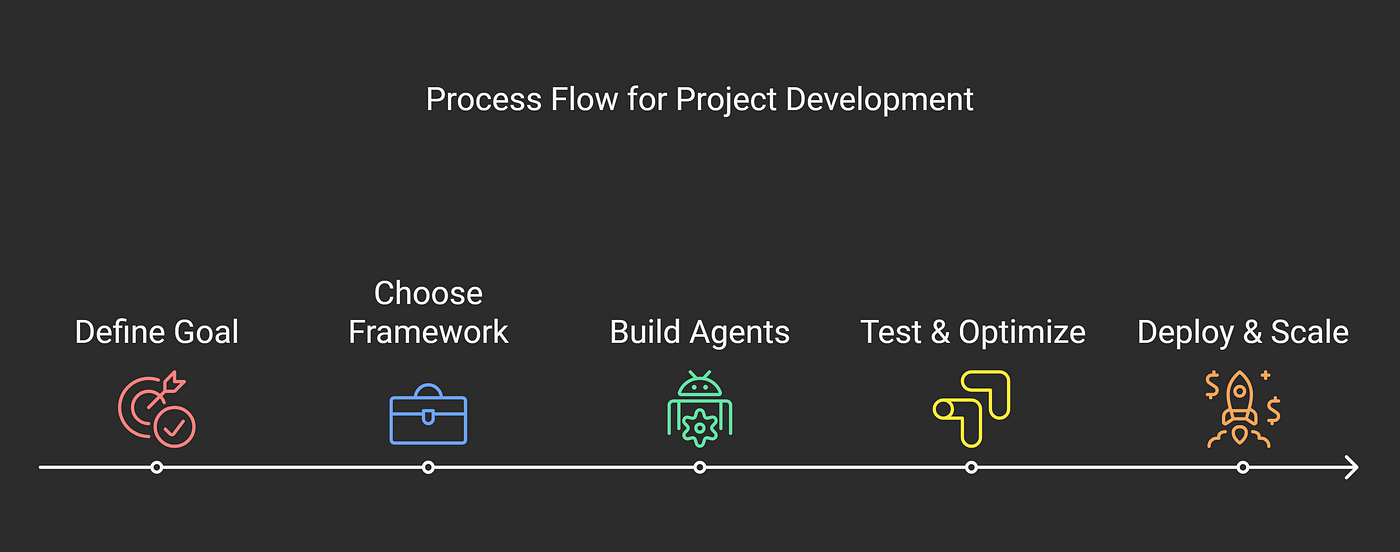
The development of an Agentic Framework involves six major phases:
- Goal Definition and Use Case Scoping
- Architectural Design
- Core Agent Development
- Tool and Memory Integration
- Orchestration and Multi-Agent Systems
- Evaluation, Scaling, and Ethical Oversight
1. Goal Definition and Use Case Scoping
Before building, it’s crucial to answer the “why”:
- Who will use this framework?
- What problems will it solve?
- How autonomous should the agents be?
- What are the boundaries of their decision-making?
- Key Outputs:
Problem Statement
- KPIs
- Constraints and Ethical Boundaries
- Domain-Specific Requirements
Example: For a fintech application, goals may include autonomous portfolio management, fraud detection, and real-time financial advisory.
2. Architectural Design
The architectural blueprint defines how components will interact.
Key Components to Define:
- Tool Use & Plugins (e.g., Web access, calculators)
- Memory Systems (short-term, long-term, vector databases)
- Planning Mechanism (task decomposition, prioritization)
- Frameworks to Explore: LangChain, Auto-GPT, CrewAI, Pinecone, Weaviate.
3. Core Agent Development
a) Model Selection:GPT-4, Claude, Gemini, or open-source models like LLaMA or Mistral
b) Prompt Engineering: System prompts (agent persona), task prompts, fallback prompts
c) Planning Engine: FSMs, Tree of Thoughts, recursive loops
d) Autonomy Layer: Decision logic, escalation thresholds, error correction
Tip: Modularize logic for easier scaling and debugging.
Get Started with Secunet
Looking for help? Get in touch with us